After Charlie Hebdo: Terror, Racism and Free Speech by Gavan Titley & Des Freedman & Gholam Khiabany & Aurélien Mondon
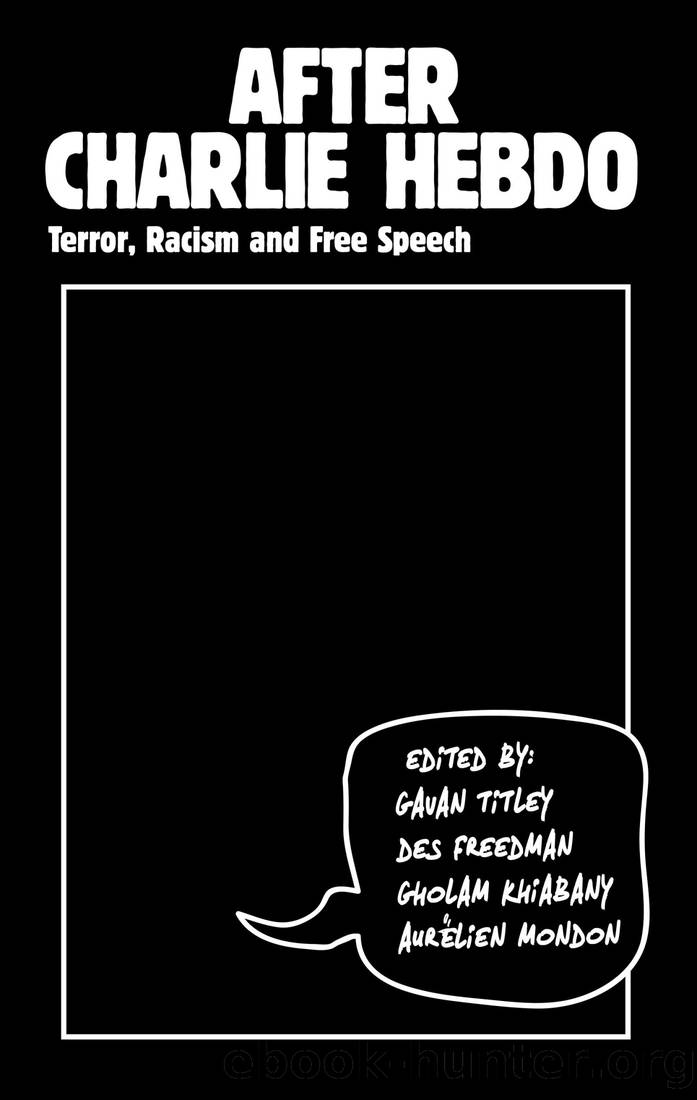
Author:Gavan Titley & Des Freedman & Gholam Khiabany & Aurélien Mondon [Titley, Gavan]
Language: eng
Format: azw3, mobi
Tags: Minority Studies, Sociology, International Relations, Social Science, General, Religion, Political Science, Politics & State, Media Studies, Terrorism
ISBN: 9781783609413
Publisher: Zed Books Ltd.
Published: 2017-11-15T15:49:17.079055+00:00
PART III
MEDIA EVENTS AND MEDIA DYNAMICS
9 | FROM JYLLANDS-POSTEN TO CHARLIE HEBDO: DOMESTICATING THE MOHAMMED CARTOONS
Carolina Sanchez Boe
On 30 September 2005, Danish newspaper Morgenavisen Jyllands-Posten published a set of political cartoons representing Prophet Mohammed. Over the next several months and years, the cartoons and stories about them circulated around the world, provoking pro- and anti-cartoon activities, more political cartoons, and reprints of some or all of the initial cartoons in various media throughout the world. In February 2006, when the cartoon controversy was âbrought homeâ to France with the publication of Jyllands-Postenâs cartoons by France Soir, the French media coverage was framed as a sudden outburst of disorder â âmatter out of placeâ (Douglas 1966) â that was to be dealt with. French media producers, whether foreign correspondents, journalists or public intellectuals, offered a selective account of what had happened in Denmark, as the event was inserted into domestic debates that were already taking place in the French media well before the controversy. These narratives were appropriated by media producers and media consumers, who ârecognize particular elements of texts as being shared by other texts they have seen and use this to construct particular âreadingsâ of these textsâ (Peterson 2005: 134). As social anthropologist Mary Douglas puts it:
In a chaos of shifting impressions, each of us constructs a stable world in which objects have recognizable shapes, are located in depth and have permanence. In perceiving we are building, taking some cues and rejecting others. The most acceptable cues are those which fit most easily into the pattern that is being built up. Ambiguous ones tend to be treated as if they harmonized with the rest of the pattern. Discordant ones tend to be rejected. If they are accepted, the structure of assumptions has to be modified. As learning proceeds objects are named. Their names then affect the way they are perceived next time: once labeled they are more speedily slotted into the pigeon-holes in future. (Douglas 1966: 37, emphasis added)
This chapter accounts for the ways in which media actors struggled over how to assign responsibility and over the appropriate responses that would restore order to what they had framed as a sudden, chaotic outburst of disorder. In the process, they defined the cartoon controversy by relating it to familiar patterns and common sets of assumptions, creating a simple narrative that could carry value judgements and references to other equally simple narratives, thus linking them to larger systems of meaning. It was a matter of only a week before the complexities of the original news stories about the cartoon controversy, as it had been reported by the centre-left Le Monde and left-wing Libération, were reduced to a simple narrative that accepted and even reinforced an orthodox discourse. This chapter analyses the competing orthodox and heterodox discourses (Bourdieu 1977) that underlay the debate on whether the cartoons should be â or should have been â published. Further, it attempts to identify the common sets of uncontested assumptions and frames of meaning behind
Download
After Charlie Hebdo: Terror, Racism and Free Speech by Gavan Titley & Des Freedman & Gholam Khiabany & Aurélien Mondon.mobi
This site does not store any files on its server. We only index and link to content provided by other sites. Please contact the content providers to delete copyright contents if any and email us, we'll remove relevant links or contents immediately.
Spell It Out by David Crystal(36110)
Life for Me Ain't Been No Crystal Stair by Susan Sheehan(35801)
Cecilia; Or, Memoirs of an Heiress — Volume 1 by Fanny Burney(32546)
Cecilia; Or, Memoirs of an Heiress — Volume 2 by Fanny Burney(31943)
Cecilia; Or, Memoirs of an Heiress — Volume 3 by Fanny Burney(31929)
The Great Music City by Andrea Baker(31916)
Professional Troublemaker by Luvvie Ajayi Jones(29650)
The Secret History by Donna Tartt(19052)
We're Going to Need More Wine by Gabrielle Union(19034)
Twilight of the Idols With the Antichrist and Ecce Homo by Friedrich Nietzsche(18622)
All the Missing Girls by Megan Miranda(15951)
Cat's cradle by Kurt Vonnegut(15334)
Pimp by Iceberg Slim(14487)
Bombshells: Glamour Girls of a Lifetime by Sullivan Steve(14054)
For the Love of Europe by Rick Steves(13905)
Talking to Strangers by Malcolm Gladwell(13346)
Norse Mythology by Gaiman Neil(13345)
Fifty Shades Freed by E L James(13232)
The Social Justice Warrior Handbook by Lisa De Pasquale(12187)
